

Searching for Adel
Meet the woman behind my house
I’m so excited to share that I’ll be one of the guests on this month’s Speakers Corner—a fun series from Projectkin that allows family historians to discuss and showcase their research. The episode releases next Thursday, June 11—there’s also a preview show on Sunday, June 7. Click here to see event details and register for Thursday’s live program, and make sure you’re following Projectkin here on Substack to see the preview and the recordings. It’s going to be a great time.
The theme of the episode is “Stories of Place,” so it’s the perfect excuse for me to talk about my favorite research project. Six years ago, when COVID kept me trapped inside my family’s 1890s Maine home, I began to research its history—who built it, when, and why. It was meant to be a simple, open-and-shut project. Now, the stories of the house’s original family have become my obsession. It was my first real foray into the world of genealogy and family history research—and even though they’re not my ancestors, the fact that we share (and love) the same home gives us a connection that, at times, feels deeper and more tangible than blood.
Regular readers of the blog will know that “the House family,” as I’ve nicknamed them, are a regular feature. I’ve serialized their stories—and my research—over several years and several posts. But as a refresher, and for anyone who is just landing here, I want to take the chance to write a full profile of one of the family members. The woman who started it all.
Warning: a long (hopefully not rambling) love letter to Adel follows. Throughout the article, you’ll find links to other posts that feature Adel’s story more in depth, if you want to explore more.
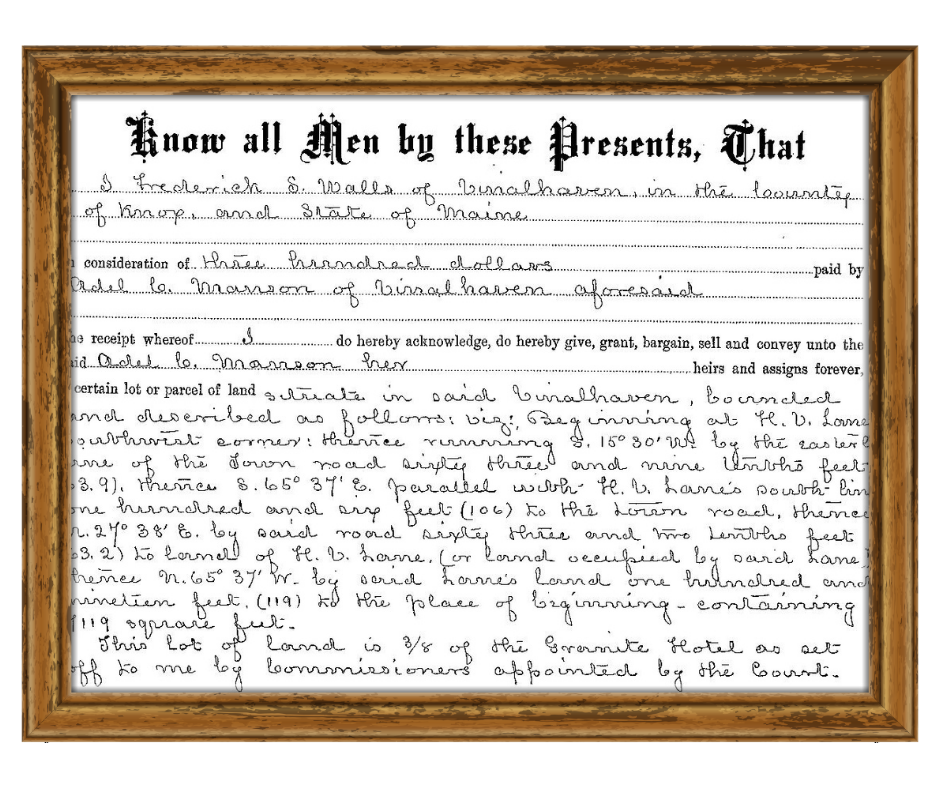
When starting my quest to find our house’s original inhabitants, I went to the deeds. Over the course of an hour in the local Registry of Deeds database, I went back through time until I hit the original deed. It immediately captured my imagination. Because, in 1896, the person who purchased the land for her family’s new home was a woman named Adel.
In 1890s America, it wasn’t unheard of for a woman to be the sole owner of a property, but statistics told me that Adel’s financial independence probably reflected her personal situation—that is, her lack of a living husband to manage things for or with her. Imagine my surprise, then, when I found the next document regarding Adel’s finances: a mortgage agreement which bears the signature of her husband, David, as a witness.
This is the moment when I fell in love. I had known her for a few minutes, but already Adel was surprising and confounding me. Not only did she possess the independent means with which to purchase property, she did so without the legal or financial involvement of her husband—reducing his role to a mere witness on her mortgage agreement. For the 1890s, this was quite the modern arrangement. My historian’s brain was suddenly swirling with questions. Who was Adel? What kind of woman was she?
These are the main questions that, as a researcher, I’ve been trying to answer for the last six years. The rest of her family is interesting, but Adel is the person who I’m always itching to know more about. Every new morsel of information I uncover only fuels the fire. Her life unfolded so dramatically that it should be a Victorian novel, not history. Unfortunately, the records don’t give me enough to paint a portrait of her personality. I don’t think I’ll ever be able to truly know her. But fact suggests that Adel was a woman who, time and time again, took the reins of her own life.
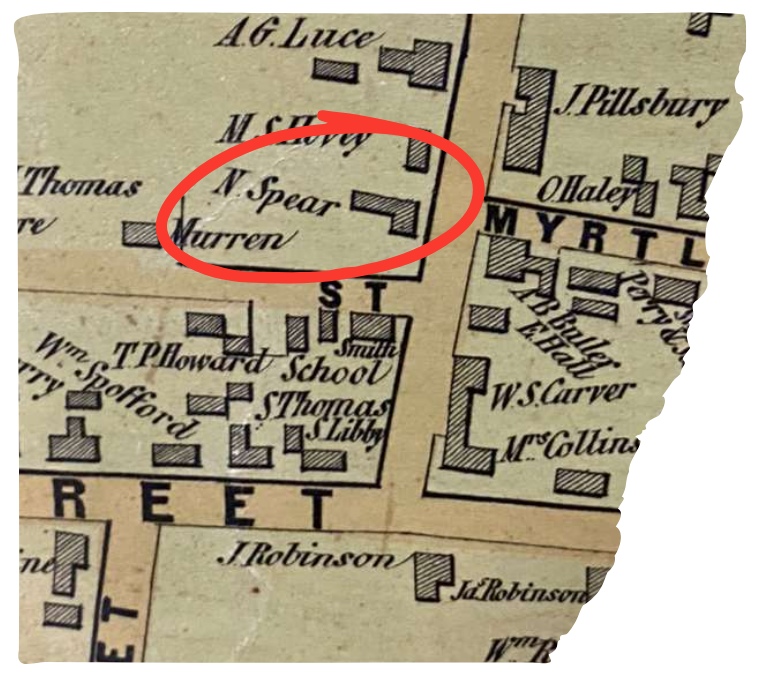
Adelcia—almost always known by her nickname, Adel—was born in January 1841 in Rockland, Maine, the daughter of a merchant mariner. Though her family was relatively well-off, living in a nice home in the city center, Adel seems to have been interested in work and reward from an early age. She took her first job in her teenage years, when she left school early to become a teacher. In fact, her childhood home sits right across the street from a school—it’s tempting to think that she taught there.
Adel probably met her first husband George—a fellow teacher—through their mutual profession. They married in November 1859, when Adel was eighteen years old. Their first child, Fred, was born in 1861. But in 1863, George embarked on a new career that would change the young family’s lives: he became the co-owner of a cargo ship, the schooner William S. Loud, and became its captain. Though it meant that the family enjoyed financial success, it also meant that Adel had to cope with her husband’s long periods of absence. She learned to manage the stresses of household management and motherhood largely on her own—though, occasionally, she accompanied George on his travels.
In July 1866, Adel was pregnant with the couple’s second child. George was on one of his usual cargo routes in Nova Scotia. Then disaster struck—news reached Rockland that the wreckage of the William S. Loud was found in the Bay of Fundy. The entire crew was presumed dead. Adel was suddenly the sole provider for her family—a burden that, in addition to the personal loss of the man she loved, must have been traumatic. In December, when she gave birth to a daughter (named Georgia Alice as a tribute to her husband), she was also dealing with probate hearings and legal settlements.
But Adel wasn’t down for long. First, she got a job as a correspondent for a Rockland newspaper, providing local news and social updates. Then, for reasons still unknown to me, she made a drastic life change: she decided to become a businesswoman.
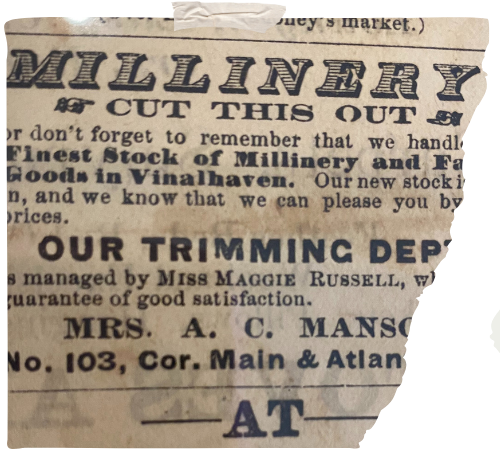
At some point in the late 1860s, Adel invested all her money (probably the majority of what George left her) into a millinery business. It sounds risky enough—now add the fact that Adel’s new shop wasn’t in her home city, but on an island thirteen miles off the coast. Vinalhaven, a long steam ship ride from Rockland, was considered somewhat of a frontier—a granite quarrying industry was just beginning to prosper, and a town with it. There were only a handful of businesses on the island when Adel moved into a building on the newly-constructed Main Street, with her young son as her only companion. Why make such a big move? Why leave her infant daughter behind in Rockland and start such a new life? The creative writer in me wants so badly to fill in these gaps.
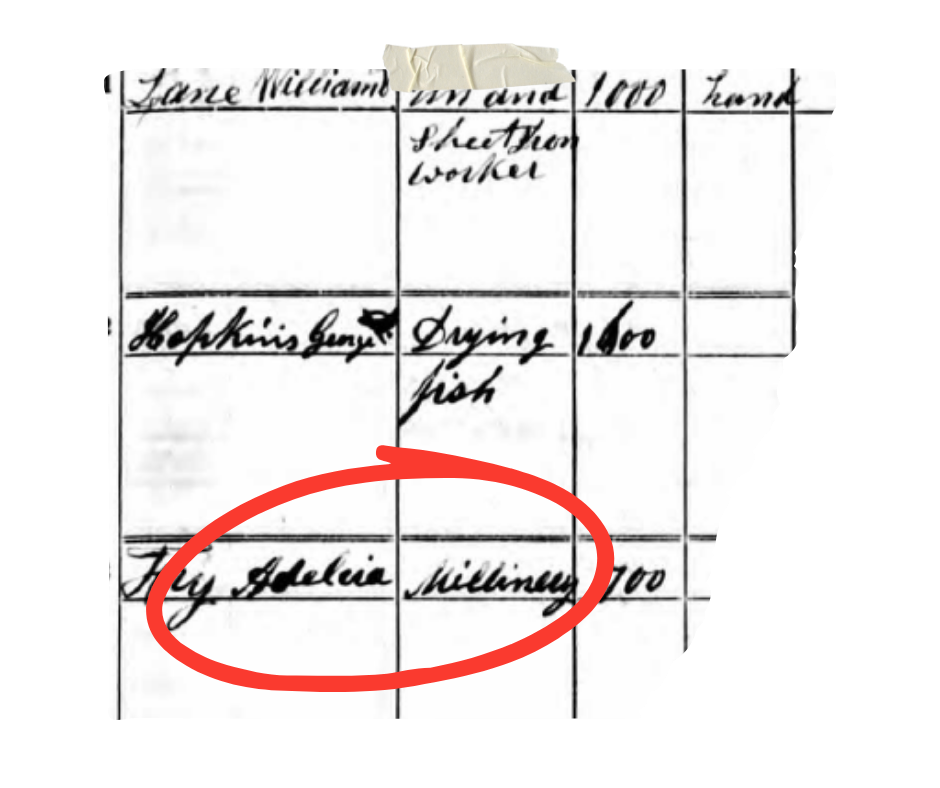
The “Industrial Schedule” of the 1870 Federal Census, a special survey of commercial operations in the United States, shows that Adel was established as the owner and proprietor of her millinery by that summer. Records suggest that she was also the first woman to own and operate her own business in the island’s emerging commercial district. The store was a fixture of Main Street for over two decades, even as the number of millineries (on this tiny island, by the way) grew to four by the end of the century.
In 1872, Adel married her second husband David, a barber who also had a shop on Main Street. He was active in town life—like Adel, a member of the fraternal organizations, charitable groups, and political clubs that dominated island society in the late nineteenth century. But for all this public life, I get the sense that David’s business sense was not as sharp as his wife’s. While Adel’s millinery remained a reliable source of income, David’s barber shops closed and re-opened in several new Main Street locations over the years. In one instance, after selling his shop to two young apprentices, David commented that he was “undecided as to what he will do.”1 Shortly after, he left the island (for reasons unknown) and doesn’t show up again for five years.
It’s just a theory, since David’s personality isn’t definitively documented anywhere, but I think it supports the couple’s odd behavior when it came time to buy their house. For all his drive and ambition, David seemed a bit unstable in his work. And as a woman, Adel must have been used to the fact that social convention tended to downplay and obscure her (perhaps superior) role in the partnership. For instance, the 1880 census—the first enumerated during Adel and David’s marriage—follows an unofficial tradition by listing Adel’s occupation as the “housekeeper” for her family (which now included Evelyn and Edith, her two daughters with David) rather than a business owner.
So in 1896, when the couple decided to build their own house in town, Adel’s role as the owner and financier was largely hidden in the family’s social circles. Rockland’s Courier-Gazette newspaper described the project as “[David’s] new house.”2 As the house neared completion, one update informed readers that he “will occupy it himself,” making no mention of his wife.3 But we know that, behind the scenes, it was actually the hard work and tenacity (and money) of a successful businesswoman who made the house’s walls go up.
For Adel, even privately, purchasing her very own home—likely the first and only she owned—was a landmark achievement in a life marked by determination and resolve. She was fifty-five years old, her children were grown, her business had been a success for decades, and she was a well-respected member of the community. The time came to finally settle down. She sold her store sometime in late 1896 or early 1897. But until her death in 1925, she remained active in island life. Unable to sit still for long, she even sold insurance on the side!
So then, who was this woman who defied my expectations? In her obituary, Adel’s daughters described her as an “energetic” woman “of progressive business mind.”4 That sounds about right. From everything I continue to learn about her, I’m no longer surprised to see her name at the top of my house’s deed. I love the house all the more for being the product of a working woman’s ambitions—a fact that I don’t want to stay hidden any longer.
There’s so much still to learn about Adel and her family—there are many more “House family” posts to come. I’m just excited that, through a few recent opportunities, I can share her story with a wider audience. If you’re just landing here, then I hope you stick with me as I continue to get to know Adel and iron out the mysteries of her life.
This is part of a series on the family I call “the House family,” the original residents of my family home in Maine. To meet them and read more, click here.
The Courier-Gazette (Rockland, ME: 18 September 1897), page 4, column 6.
The Courier Gazette (Rockland, Maine: 9 June 1896).
The Courier-Gazette (Rockland, Maine: 1 September 1896).
“Adel C. Manson,” Courier-Gazette (Rockland, ME) 10 February 1925, p 5 col 4.
How interesting! I look forward to learning more about Adel and the history of your house.
Great story, and I'm so glad you researched your house history. Have you also presented this to the local historical society, either in content or a presentation? Have you talked with other folks about the history of the time, and found any connections to Adel through those discussions?