

Adel, meet David
In this episode: Adel meets and marries her second husband
The days and nights are getting cold. As I write this, my desk chair and I are wrapped up together in a blanket. Unfortunately, it means that it’s almost the end of this year’s stay on Vinalhaven. By the time winter comes, we won’t be able to live in such a cold house.
Being here has been such a privilege. I’ve been able to do fascinating freelance research, spend time with family, and exist in a place that I love. Being in this house, especially, has reminded me of the lives that were lived within these walls—and the fact that I promised you another installment of their stories.
Now, where did we leave off? Adel was a young widow whose husband died at sea and left her with two children. Needing income and stability, she moved to Vinalhaven—a town booming with the granite industry—and opened a successful millinery shop. When we next encounter Adel in the public record, she’s decided to take another step into her future: she’s getting married again.
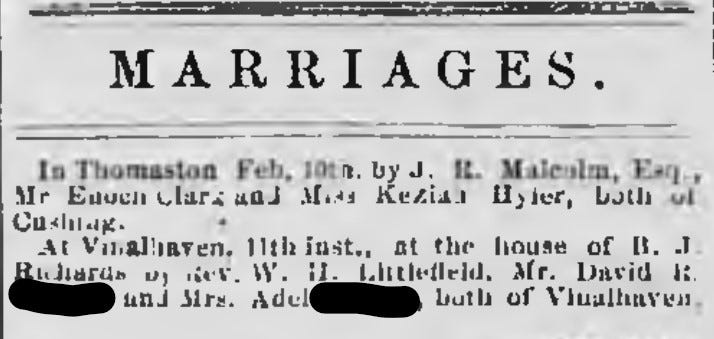
On February 11, 1872, Adel married a man named David. The service was small, taking place at the home of a friend in the middle of some particularly snowy weather. We don’t know anything about the couple’s courtship or early relationship—and just like Adel, details of David’s early life are somewhat scarce.
Born into a large family in Farmington, Maine, David was six years Adel’s junior. When he was in his early twenties, he moved out of the family home and settled in Rockland—Adel’s hometown, just over the Bay from Vinalhaven. He appears in Rockland’s City Directory in 1868, working as a “hair dresser” and boarding with a local family. A “hair dresser” is, of course, a barber—the trade that David seems to have fallen into from a young age. Two years later, the 1870 census lists him at the same address, still working as a barber. At this point, it’s unclear whether David is an employee at a barber shop or is the owner of his own place.
Sometime between the summer of 1870 (when the census was enumerated) and the winter of 1872 (when he married Adel), David moved to Vinalhaven. He worked for himself, leasing a small shop in the back of a doctor’s office in the town’s main drag. When Adel met him, he was just starting to make a name for himself as a barber and businessman on the island.
It’s totally possible that, once David arrived on Vinalhaven, he fell in love with Adel. She was in her early thirties and a successful businesswoman—why not? But as much as we want a romantic story, it’s also possible that Adel came at this from a more realistic perspective. Raising two young children as a single parent, in addition to running a business, is hard—now add on the stress and prejudice of nineteenth-century behaviors towards single women. Feeling somewhat vulnerable, Adel would’ve wanted security and extra income to support her kids—not to mention a companion for herself.
So far, I haven’t been able to find any mention of Adel and David’s private life together—things that might mention their feelings and emotional connection. It doesn’t mean there wasn’t one, just that this was a no-nonsense, all-business couple. Objectively, they thrived together.
There is one hint that may suggest David’s attitude towards the marriage. In most instances, David refers to Fred and Allie—Adel’s children with George, her first husband—as his own son and daughter. He didn’t legally adopt them—their surnames stayed the same and legal documents note them as David’s stepchildren. Locally and within the family, though, he thought of himself as their dad, a gesture that seems pretty loving to me.
There are a lot of mysteries surrounding the relationship of this couple, so it’s fun to speculate about their feelings. As I’ll tell you in later blog posts, a lot of things happened that may suggest some rocky points in the marriage. But like I said: this couple did really well. They had two kids of their own, daughters Evelyn (born in 1873) and Edith (born in 1877). They kept up separate established businesses that became staples of the island economy. And they built a house together—which I’m extremely grateful for, as I sit in a bedroom that belonged to one of their children.